


Al 3.500+ gebruikers vertrouwen op Adaption
Document management in transport: all transport documentation centralized in your TMS system
In transport and logistics, organizations process dozens of documents every day. CMR waybills, proof of delivery documents, and customs paperwork: every document must be available at the right moment for the correct shipment, trip, or customer. When that connection is missing, delays and incorrect invoices occur.
With Adaption, you bring document flows together in one integrated environment within the TMS System. You manage transport files, link documents to the correct order, and share statuses with colleagues, drivers, and customers.
You eliminate unnecessary searching because all transport documents are centrally available.
You speed up processing because everyone works from the same digital files.
You maintain control over compliance becausedocumentation is stored in a structured way.
Discover in 15 to 30 minutes how Adaption’s TMS system supports your document management.
"*" indicates required fields
TRUSTED BY LOGISTICS LEADERS SUCH AS





Adaption’s TMS for document management

Recognizable problem
Transport documents getting lost or arriving too late
Many transport companies still work with a combination of email, shared folders, and paper waybills. A driver hands in a CMR to the consignee, the scan only arrives the next day through WhatsApp, and invoice approval is delayed. Meanwhile, a customer requests delivery confirmation while the proof of delivery is not centrally available anywhere.
As volume increases, this problem grows larger. Documents get lost and versions become mixed up. This costs time and increases operational pressure on your team. A structured solution for digitally managing transport documents is therefore not a luxury, but an operational necessity.
Adaption's logistics solution
Adaption TMS as the central location for all your transport documentation
Adaption organizes document flows as part of the logistics process, not as a separate folder alongside operations. Files are linked to shipments, trips, orders, stops, customers, and invoice lines, ensuring every department uses the same information. With automatic document processing, you avoid unnecessary manual steps while maintaining visibility into the status of every file.
The 5 benefits of document management with Adaption TMS software
1. Automatically linked to the correct trip
Every document is directly linked to the correct shipment, trip, or order, ensuring supporting documents, CMRs, and customer attachments no longer remain scattered across inboxes. Planners can immediately see which files are complete and which are still missing a document, while document control follows the same structure as your planning.
2. Less searching, more visibility
By organizing your transport documentation centrally, you no longer work with separate drives, inboxes, and Excel lists. Employees can find every file by customer, order, trip, or license plate, while customers and partners can view documents immediately once they become available.
3. Digital waybills and CMRs without paperwork
Drivers and planners work with digital versions of waybills and CMR documents that are instantly available for customers, carriers, and customs, without additional scanning work or loose paperwork in the operation.
4. Faster invoicing and audit-ready compliance
Delivery notes, waiting hours, surcharges, and customer agreements are directly linked to the correct file, so invoicing no longer has to wait for missing proof. CMR documents, customs papers, and customer instructions are stored within the process, allowing you to quickly demonstrate during an audit which steps, documents, and agreements belong to a shipment.
5. Integration with WMS and FMS for a complete file
Adaption connects document flows to the Warehouse Management System and Freight Forwarding System, giving you one traceable file for the entire supply chain without having to search for information across systems.

Prefer to get acquainted first or receive more information before booking a free demo?
We are happy to help, feel free to contact us.
Which documents can you manage with Adaption’s TMS?
Within the TMS, Adaption supports different types of transport documents. The setup is not limited to a fixed list but is aligned with your processes, transport modes, customers, and document flows. You can therefore also manage other documents that are relevant to your operation. Common documents you can register and manage include:

Basic transport and trip handling documents
Airway Bill (AWB)
An Airway Bill (AWB) is an air freight document used for air cargo shipments. The document records the transport agreement between the sender and the air carrier and serves as a receipt for the goods.
CMR waybill
A CMR waybill is an international consignment note used for road transport. The document contains information about the sender, carrier, consignee, cargo, and final destination of the goods.
Digital waybill or digital transport document
A digital waybill or digital transport document is an electronic transport document used for daily trip handling. The document supports administrative processing, proof management, and digital confirmation of transport assignments.
Bill of Lading (B/L)
A Bill of Lading (B/L) is a sea freight document that records the receipt, ownership, and delivery of goods. The document is used as proof that the goods have been received by the carrier and will be delivered under specified conditions.
Bill of Lading instructions
Bill of Lading instructions are guidelines that inform the carrier or freight forwarder how the Bill of Lading should be prepared correctly. These instructions usually include details about the sender, consignee, goods, loading location, unloading location, and required document wording.
Vessel Arrival Notice
A Vessel Arrival Notice is an arrival notification for sea freight. The document informs involved parties about the expected arrival of a vessel so they can prepare in time for unloading, customs clearance, and further distribution.

Rail, customs, dangerous goods, and proof documentation
Railway Booking
A Railway Booking is a booking document used for rail transport. The document contains reservation details, cargo information, and the planned departure and arrival times of the rail shipment.
EUR certificate of origin
A EUR certificate of origin is an origin document used to demonstrate where goods originate from. The certificate may be required for import duties, trade agreements, or preferential tariff treatment.
TR1 export document
A TR1 export document is an export document used in goods flows where customs handling and export control are involved. The document supports the formal processing of export shipments and the control of goods movements.
Multimodal dangerous goods documents
Multimodal dangerous goods documents are transport documents for hazardous goods transported through multiple transport modes. These documents help demonstrate that the transport complies with regulations such as ADR, IMDG, or IATA.
Proof of Delivery documents
Proof of Delivery documents are delivery documents used to demonstrate that goods have been delivered. Examples include delivery confirmations, signed receipts, photos, or digital confirmations after delivery.
Transport invoicing documents
Transport invoicing documents are documents required for accurate invoicing of transport services. These include attachments, surcharge evidence, waiting time registrations, and customer agreements that support the final invoice.
By managing these documents centrally, one digital file is created per shipment, order, or trip. This allows planners, administration, customer service, and management to work from the same information without documents remaining scattered across inboxes, network drives, or separate customer folders.
How do you process incoming documents into a complete transport file?
Registering documents where they belong
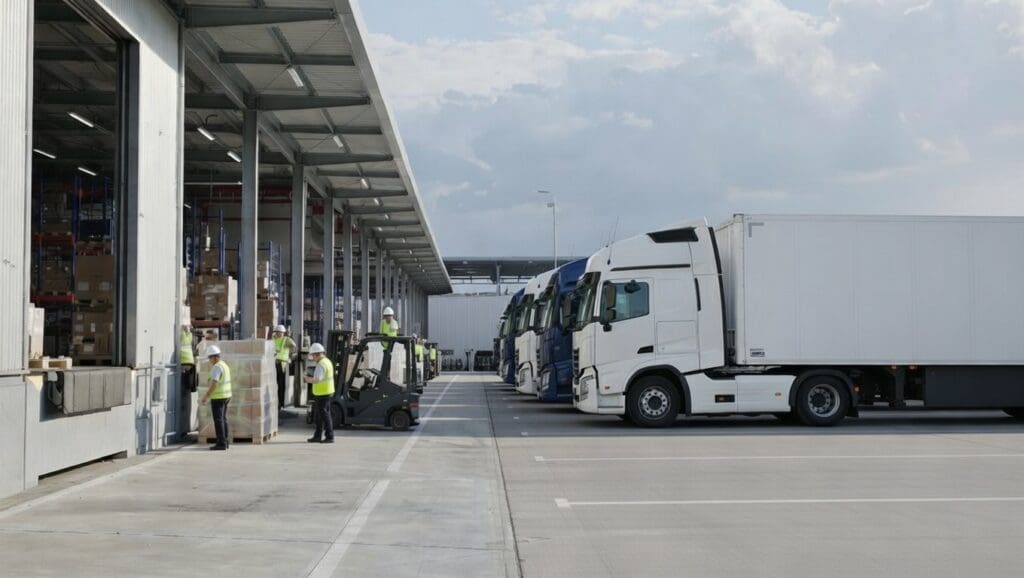
Transport documents arise at different moments. A planner adds trip information while a driver provides supporting documents during transport. In Adaption, these documents are directly linked to the operational location where they belong. This may be a shipment, but also an order, trip, vehicle, customer, file, or invoice line. This keeps the relationship between document and process clear.
Less fragmented handovers between departments
When documents are registered directly within the TMS, information no longer needs to be manually forwarded. Planning teams can see which instructions are available, customer service can answer customer questions more quickly, and administration knows which files are complete.
This prevents the same information from being stored or checked multiple times. The document becomes part of the transport process instead of a separate attachment alongside the process.
How do you use transport documents in the TMS system during planning and execution?
Available before departure
For proper trip execution, the correct documents must be available before the driver departs. Think of loading references, unloading instructions, customer agreements, CMR documents, customs papers, or dangerous goods documentation. When this information is linked to the trip or shipment, planners no longer need to search separately or send documents manually.
This is especially helpful for international transport, groupage, and multi-stop transport. In these situations, one operation often consists of multiple stops, customers, and document types. By linking documents to the correct trip or shipment, execution remains organized.

Adding proof after delivery
After delivery, POD documents, photos, signed waybills, or deviation reports can be added to the transport file. This immediately shows whether a delivery has been fully completed and which supporting documents are available.
This is valuable for customer service and administration. In the event of customer questions, claims, or invoice checks, the team can quickly retrieve what was delivered, when it happened, and which proof belongs to it.

How does a transport file help with invoicing, compliance, and customer information?
Faster administrative processing
Once a trip has been completed, the file often moves to invoicing or verification. This requires documents such as waybills, PODs, surcharge evidence, waiting time registrations, and customer agreements. If these documents are already linked to the correct file, administration can more quickly determine whether a shipment is ready for invoicing.
Exceptions are also better substantiated. Think of damage photos, waiting times, additional loading or unloading activities, or additional customer instructions. By registering this information with the shipment, discussions afterward are reduced.
Better prepared for compliance questions
For international logistics, correct documentation is essential for compliance and accountability. CMRs, customs documents, export documents, and dangerous goods documents must not only be available, but also remain easy to retrieve. Adaption helps store these documents in a structured way within the transport file.
This makes it easier to answer questions from customers, carriers, customs authorities, or internal auditors. Teams no longer need to rely on separate folders or individual inboxes but instead work from one centralized file.
Seamlessly integrates with your current IT landscape
Adaption integrates seamlessly with your existing IT landscape and connects with the systems you already use. From ERP systems and webshops to carriers and accounting packages, all data flows come together in one logical whole. Thanks to open APIs, virtually any integration is possible. If your system is not listed, we will make it fit.






Frequently asked questions about TMS document management
It mainly delivers greater visibility, faster processing, and less dependency on separate inboxes. A transport company can manage transport documents from one file per shipment, trip, or customer. This makes it clearer which files are complete and which still need to be supplemented.
Yes, the solution is suitable for transport companies operating internationally that often need to store digital CMRs, customs documents, and customer attachments. You can manage CMR documents within the transport file, ensuring the information remains available for planning, administration, and customer communication. Customs document management also becomes more organized because files are stored with the correct shipment.
Multi-stop trips often generate multiple supporting documents per trip, such as delivery notes, photos, and signed waybills. By linking documents to trips, planners can see per stop which documents are available. This also supports loading and unloading scheduling, because instructions and supporting documents become available more quickly.
Yes, you can add files in the TMS at different moments within the process. This can be done during order registration, execution, or after delivery, depending on the setup. As a result, TMS document management is no longer postponed until the end of the day but becomes part of the daily workflow.
Yes, Adaption supports storing digital transport documents and proof of delivery within the transport process. Managing proof of delivery helps complete deliveries faster, answer customer questions more effectively, and support invoicing. This prevents supporting documents from having to be requested separately afterward.
Yes, you can review waybills in relation to trips, shipments, customers, and invoice lines. This makes it easier to verify invoice documentation before closing a file. In the case of claims or customer questions, the relevant supporting documents can be retrieved more quickly.
Logistics file management integrates with TMS, WMS, and Freight Software within the same cloud environment. This allows linking documents to shipments, orders, trips, and invoices as part of one process. This is especially useful when transport, storage, and forwarding activities overlap within the operation.
Yes, this processing is particularly relevant when the number of customers, trips, and document types increases. It helps link files more quickly, track statuses more effectively, and reduce manual checks. This allows you to manage transport documents digitally without administrative pressure growing at the same pace.
Take the next step toward complete digital transport file management
Would you like to know how Adaption helps your organization manage transport files, register customs documents, and better connect loading and unloading planning with daily operations? Schedule a free demo with Toon Schilder.
During the demo, you gain insight into:
How the TMS works in practice
Support for your logistics processes
Integration and expansion possibilities
Or contact us via:
Schedule a free demo with Toon Schilder
Discover in 15 to 30 minutes how Adaption’s TMS system supports your document management.
"*" indicates required fields