

Why is Adaption actually at ICT&Logistics 2026?
Of course, Adaption is attending ICT&Logistics to meet existing relations, connect with new people and show what we are working on as an organization. But if that were the only answer to the question of why we are exhibiting, it would be rather generic.
That is why I, Marcel Hoogenraad, Manager Custom Solutions at Adaption, put this question to Toon Schilder, Business Development and co-owner of Adaption.
Marcel: “Toon, there will be quite a few logistics software suppliers in Utrecht. Almost everyone talks about WMS, TMS, automation, integrations and digitalization. So why should someone specifically stop by Adaption?”
Toon does not have to think long about his answer.
Toon: “Because things become especially interesting for us when a logistics company says: our operation works just a little differently.”
And that actually sums up quite well why we are at ICT&Logistics.

Visit Adaption at Jaarbeurs Utrecht
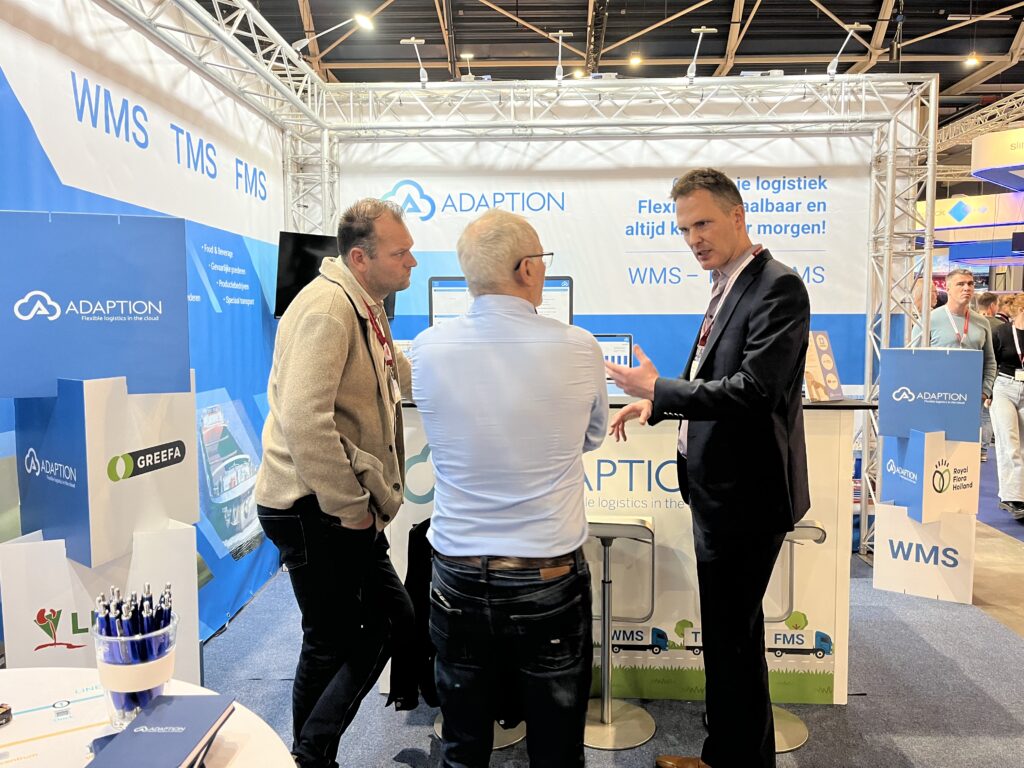
Are you visiting ICT&Logistics? Stop by Adaption and discuss directly with our specialists where improvements can be made within your organization. Schedule an appointment with us at the exhibition below.
The Logistics Cloud Suite is our starting point
Adaption’s main product is our Logistics Cloud Suite. Within this platform, we support warehouse management, transport management and freight forwarding, among other areas. These are not unique concepts in themselves, of course. There are plenty of software suppliers offering a WMS, TMS or freight forwarding solution. For us, the main difference lies in the logistics processes underneath.
Toon: “For many companies, a standard process works perfectly well. A pallet arrives, is assigned a location, gets picked and eventually leaves the warehouse again. Or a transport order is planned, executed and administratively completed.”
“But logistics does not always fit neatly into a standard process. Some organizations have a product, storage method, planning process or combination of activities that creates different requirements. That is where an important part of our specialization lies.”
Within Adaption, we often refer to this as a specialty. That does not mean a logistics operation necessarily has to be complicated. For the people working with it every day, it is often simply their normal process. But somewhere in that process there is something that means a standard solution does not quite fit.
Bulk logistics requires different software logic
A clear example is bulk logistics. A traditional warehouse process is often structured around pallets, boxes, quantities and fixed locations. With dry or liquid bulk, the reality is different.
Goods can be stored in silos, tanks, bunkers or other forms of bulk storage. Quantities change continuously and batches can be split, combined or moved. And sometimes much more happens while the goods are in storage.
Marcel: “That brings you to processes such as mixing and decanting, for example?”
Toon: “Exactly. Those are good examples of why bulk is a specialty for us. If you mix different batches together, you do not just want to register an inventory movement. You want to know which batches were used, what quantities went into the process and which new batch was created as a result.”
“With decanting, something different happens. Product is transferred from one packaging or storage unit to another. Here too, you need to maintain accurate control over inventory, origin and traceability throughout the process.”
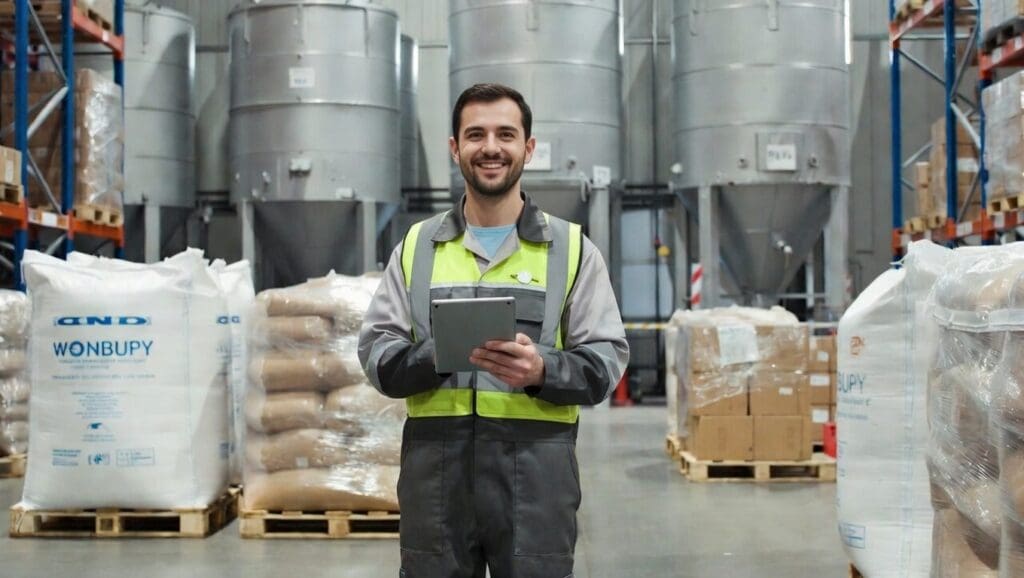
For a bulk operator, these are not unusual exceptions. They are part of the daily operation. And that is exactly what the software needs to support. Toon: “We believe you should not use software to force a process into a standard template. The software should be able to align with how the logistics operation actually works.”

Dynamic logistics: when reality keeps changing
Another logistics environment where different requirements apply is what we increasingly refer to within Adaption as dynamic logistics.
Think, for example, of fresh produce, flowers and plants, food and temperature-controlled transport. A plan may be completely accurate in the morning and already outdated a few hours later. Volumes change. Products become available later. A delivery time changes. An order becomes larger or smaller. A transport suddenly needs to be combined differently.
Toon: “In this type of operation, planning is not a snapshot. Throughout the day, you are continuously reassessing what is happening and what the consequences are for the rest of the plan.”
That is why it is not just about creating a transport plan. A planner primarily needs to be able to deal effectively with changes.
What happens when an order changes? Which trips are affected? What capacity remains available? Can orders be combined differently? And which changes then need to be communicated to drivers, customers and other parties involved?
Fresh or temperature-controlled products often come with additional conditions. Shelf life, temperature, time windows and availability all play a role. In that case, you need more than software that simply allows you to register transport orders. You need an environment designed for an operation that changes continuously throughout the day.
Freight forwarding and warehousing are not always separate worlds
Within freight forwarding, we also see processes in which different logistics disciplines come together.
A freight forwarder may organize sea freight, air freight or road transport, while also providing storage and handling services for customers.
Marcel: “In that case, forwarding and warehousing effectively become part of the same operational process.”
Toon: “Yes. Yet in many organizations and software environments, those two worlds are completely separate. But if goods are received from a forwarding file and then placed into storage, you do not want to rebuild the same information from scratch.”
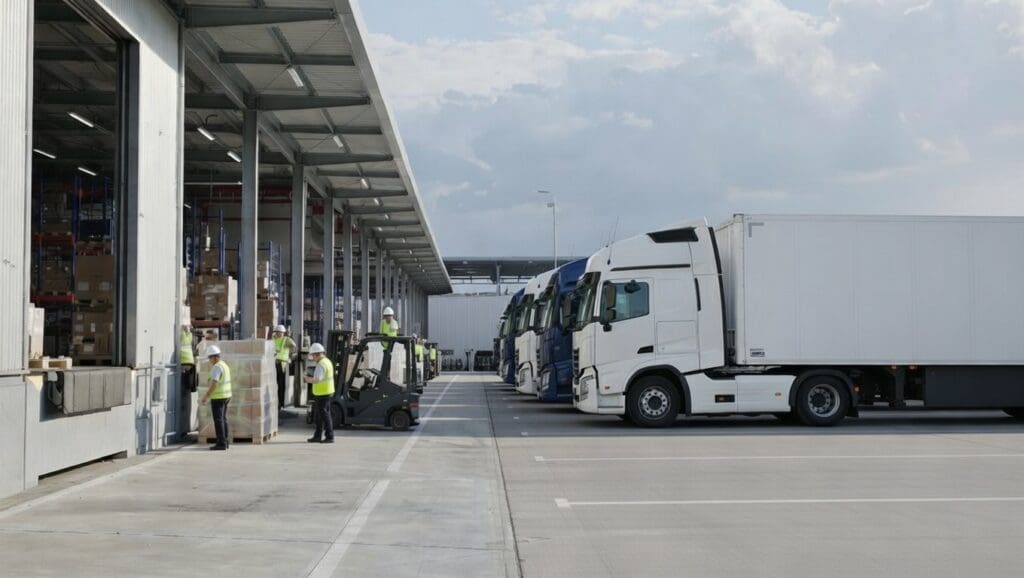
It becomes even more interesting when customs is also part of the process. For example, in bonded warehousing. In that case, it is not enough to know where goods are physically stored. Their administrative and customs status must also remain correct throughout the process. According to Toon, this is exactly where it adds considerable value that warehouse management and freight forwarding are part of the same Logistics Cloud Suite.
Toon: “This allows us to look at the entire process. Not just forwarding and not just warehousing, but specifically at the points where those disciplines intersect.” For logistics organizations that perform both activities, that combination can make an important difference.

Project logistics requires a different form of registration
Project logistics also has its own characteristics. Transport is not always simply about moving a shipment from A to B. One project may involve multiple transports, activities, assets, documents, agreements, costs and milestones.
Toon: “In project logistics, transport is often only one component of a much larger process. You may want to record which activities were performed, which assets were used, which documents belong to the project and which costs arise throughout its duration.”
Deviations and progress also become more important. What has been completed? What is still open? Who was responsible? Which documents have been received? Which activities still need to take place? That requires more than standard transport registration.
And once again, the same principle applies: the software must be able to align with the organization’s logistics reality.
A strong standard, with room for specialties
That does not mean that everything within the Logistics Cloud Suite is reinvented for every customer. Quite the opposite.
Toon: “Our Cloud Suite remains a standard product. That is important, because you do not want to start from scratch for every organization.”
“But within that standard, we have developed more and more capabilities over the years for companies with specific logistics processes. That is exactly where I see the strength of the platform. Where the standard works well, you use the standard. Where a process is genuinely different, there needs to be room to support that.”
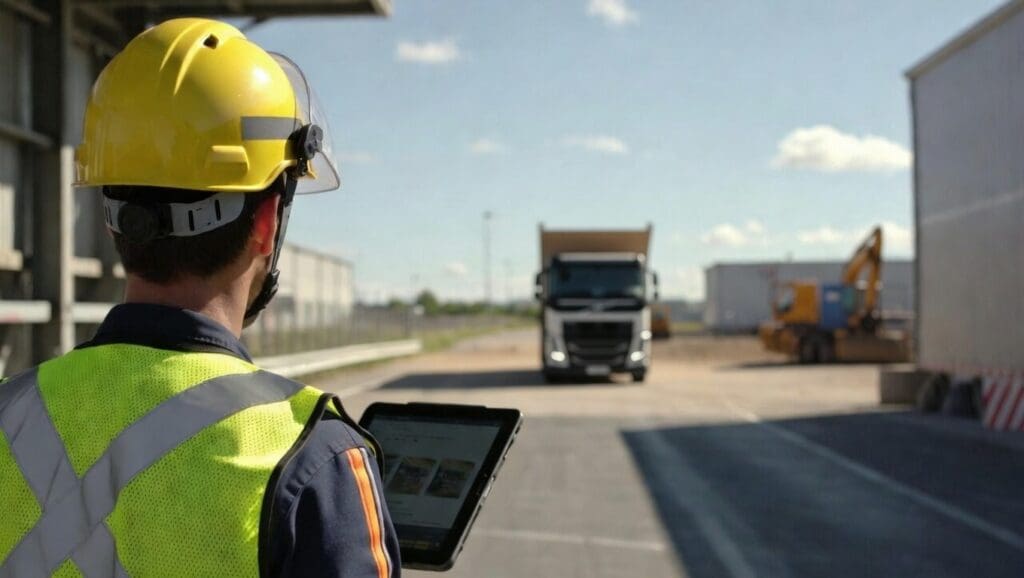
That is also how we want to approach demonstrations at ICT&Logistics. Rather than opening as many menus as possible or going through a long list of features, we prefer to start with the process. How is a bulk batch received, stored, mixed and dispatched again? Or what happens when a transport plan changes during the day? That makes the software much more tangible.
You do not just see which functionality is available, but more importantly why that functionality is needed in a specific logistics environment.
How do we use Artificial Intelligence (AI) within Adaption’s logistics software?
Within Adaption, AI is increasingly being used in practical applications as well. For example, we use AI to automatically process information from PDF documents when creating customer orders and to convert PDF purchase invoices into invoices within the system. Not because AI is a goal in itself, but because it can reduce manual processing within existing logistics processes.
We will soon explore in more detail how we use AI within Adaption and which opportunities we see in a separate blog.
Not every logistics organization is looking for a new software package
Sometimes a conversation leads to an entirely different situation. Not every logistics organization works with a standard software package. Some large organizations have had their own custom-built system developed over the years, fully designed around their specific processes. That brings us to another discipline within Adaption: Custom Solutions.

Adaption Custom Solutions
Marcel: “Custom Solutions is the area I have been working in for almost seven years now. The organizations we support through Custom Solutions often rely on business-critical software that was originally developed entirely as a custom solution.”
This is not a standard licensed product. These are custom software environments that have become deeply embedded in the customer’s operation over many years. And at some point, that can create a challenge.
The original development partner may no longer be involved. A system may still be used every day but is no longer actively maintained. Or the organization may need new functionality while the party that originally developed the system is no longer available.
Marcel: “As a development partner, you are not stepping into an empty environment. You are entering an existing custom-built system that an organization may have relied on completely for years.”
“First, you need to understand how that environment is structured, which logistics processes it supports and why certain decisions were made in the past. Only then can you responsibly start extending it.”
This could involve implementing an integration with Portbase, further developing Asset Management or expanding a Trip Planboard within an existing custom software environment.
A strong standard, with room for specialties
Custom Solutions is not a new activity within Adaption. Custom software development has been part of the company since the very beginning.
Over the years, Toon and Ronald Korporaal, the owners of Adaption, have primarily focused on the continued development of the Logistics Cloud Suite.
In December 2019, I took over responsibility for custom software development. Since then, I have been working with a team on existing custom software environments for two large multinationals.
Toon: “It is important to keep that distinction clear. Our Logistics Cloud Suite is and remains Adaption’s main product. That is where our primary focus lies.”
“Custom Solutions is a different discipline that has been part of our organization for a very long time.”
For me, the common ground lies mainly in the logistics knowledge that is required.
Marcel: “Whether you are working on our own Cloud Suite or within an existing custom system for a large logistics organization, you need to understand what is happening operationally. Writing technically sound code is not enough if you do not understand which logistics process you are supporting with it.”
Over the past few years, we have also seen that the need for this type of support appears to be broader. More logistics organizations are working with existing custom systems that still require further development, but where the original development partner is no longer available or where there is a need for a new partner that can maintain and expand the system.
That is why I will also be explicitly present at ICT&Logistics this year on behalf of Custom Solutions. We will explore that topic in more detail in a separate blog soon.
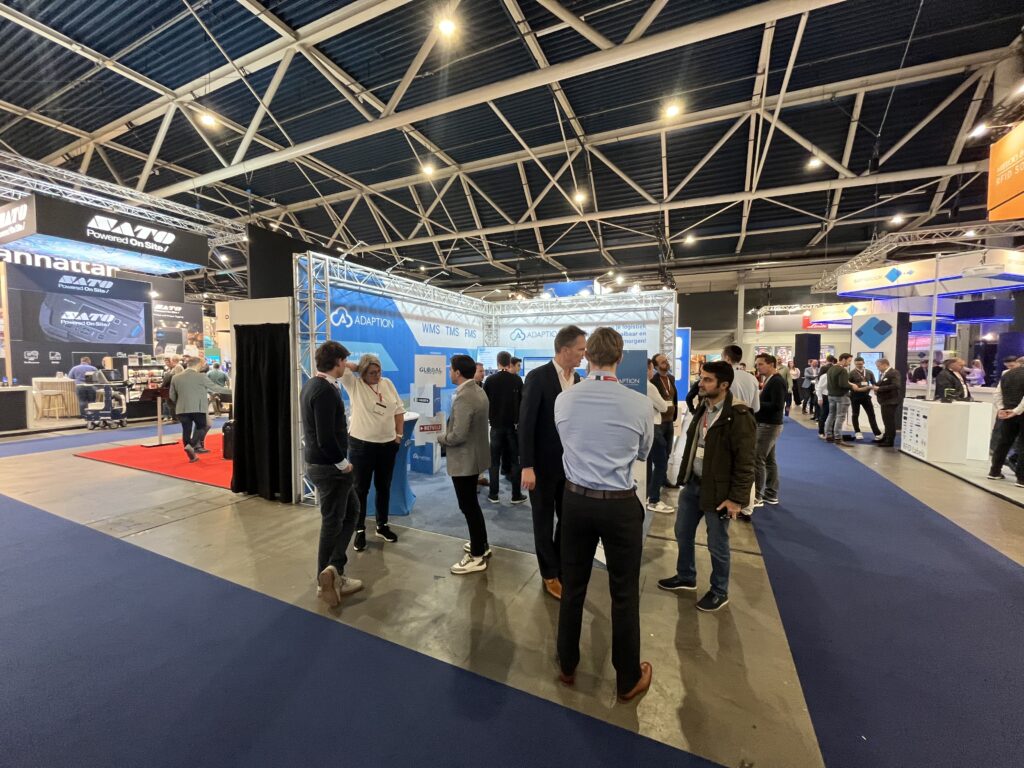
What do we mainly want to show at ICT&Logistics?
That brings us back to the original question. What is our presence at ICT&Logistics mainly about? For Toon, the answer is clear.
Toon: “Our Logistics Cloud Suite and the logistics processes we have developed it for over the past few years.”
Not just a WMS. Not just a TMS. And not just freight forwarding. Above all, it is about what happens when logistics works just a little differently.
Toon: “If someone from the bulk sector comes to us, I first want to understand how goods are received, stored and processed. If a carrier deals with many last-minute changes, I want to know why the planning is so dynamic. And if a freight forwarder also handles warehousing, it becomes interesting to see how those processes are connected.”
Only then does the software come into the conversation. Because at that point, you can show much more specifically how the Logistics Cloud Suite fits the operation.
Who is a visit to our stand interesting for?
Not only organizations that have already decided they need a new WMS, TMS or freight forwarding system. It is also particularly relevant for companies that notice their logistics process does not fit completely within a standard solution.
A bulk operator that mixes, splits or decants batches. A carrier that continuously has to respond to changing orders, volumes and delivery times throughout the day. A freight forwarder combining forwarding with warehousing and bonded processes. Or a project logistics organization that needs to register far more around a transport than just an order and a trip.
Those are exactly the conversations we are looking forward to.
And there will undoubtedly also be organizations at the exhibition that are not looking for a new software package at all, but do work with an existing custom environment that needs further development or maintenance. I will also be there representing Custom Solutions for those conversations.
So, why are we actually at ICT&Logistics?
I return to my original question one final time at the end of our conversation.
Marcel: “So if someone is walking through Jaarbeurs Utrecht and wonders why they should stop by Adaption, what would you say?”
Toon: “If your logistics operation is completely standard, there are many good solutions available. But as soon as you say: this works just a little differently in our organization, that is when it becomes interesting for us.”
That difference may lie in your product. In your storage operation. In your transport planning. In the combination of freight forwarding and warehousing. Or in everything that needs to be registered around a logistics project. That is exactly the type of logistics for which we have continued to develop our Logistics Cloud Suite.
And that is exactly why we will be at ICT&Logistics at Jaarbeurs Utrecht on 3, 4 and 5 November 2026. So feel free to stop by. And do not start by telling us which software package you are looking for. Instead, tell us:
What works just a little differently in your logistics operation?