

Warehouse optimization
5 tips for an efficient warehouse operation in 2026
Efficiency in warehousing rarely comes from one major intervention. Many logistics organizations rightly invest in software, automation, and real-time insight. A modern warehouse management system (WMS) helps you plan work, manage exceptions, and measure performance. But technology only really delivers results if you are clear about which operational problem you are solving. Otherwise, you mainly embed existing inefficiencies in a new system.
Quick Navigation:
- Tip 1: Make picking faster with smart slotting
- Tip 2: Increase inventory reliability with cycle counting
- Tip 3: Handle labor pressure with standard work and real-time task management
- Tip 4: Prevent congestion by orchestrating inbound and docks
- Tip 5: Make data quality a fixed discipline, not an incident
- Conclusion: Warehouse efficiency
Warehouse optimization: 5 practical tips
Warehouse optimization does not start with technology alone, but with recognizing recurring friction in your warehouse processes. Where do people lose time? Where do errors occur? Where does work pile up? And which exceptions keep recurring? If you make those pain points measurable, you can improve in a targeted way. Sometimes with process agreements and working methods, sometimes with a better layout, task management, or data quality, and often with software as an accelerator that embeds the new process.
Anyone who wants to optimize a warehouse must first understand where the biggest waste in the operation lies. The 5 tips below are practical, recognizable, and proven relevant in warehouses with variation, exceptions, and complex processes, such as bulk storage, cross-docking, value-added services, and customs processes. For each tip, you will read a familiar situation, the pain point, the solution, an approach, what you measure, and a common pitfall.


These are the 5 tips you will find in this blog:
- Improve slotting based on order data
- Cycle counting for higher inventory reliability
- Standard work and real-time task management for more output per employee
- Orchestrate inbound with dock planning and focus on dock-to-stock
- Ensure data quality and integrations to prevent exceptions
Tip 1: Make picking faster with smart slotting
Familiar situation
It is Monday morning. The first wave of orders needs to go out. Pickers walk many meters, regularly stop to search, and run into each other in the same aisles. By the end of the morning, the packing area is full, while everyone feels like they have only been walking.
The pain point
Picking often costs the most time and money in a warehouse. If fast movers are spread out, locations are illogical, and replenishment interrupts too often, productivity drops and lead time increases.
The solution
Set up locations based on order data. Slotting is not a one-time project, but a repeatable process that moves with demand, seasons, and customer mix. Smart slotting is one of the fastest ways to increase warehouse efficiency.
The approach
- Analyze order lines and determine your fast movers based on order lines, not just on order counts.
- Optimize pick locations: fast movers close to collection and packing points, at grab height, with sufficient stock space.
- Prevent disruption from replenishment: schedule replenishment at fixed times or based on clear triggers.
- Look at items that are ordered together and place them logically near each other in the same zone or walking sequence.
What you measure
Picks per hour, walking time per pick, order lead time, number of replenishments during peak hours.
Pitfall
Moving things based on gut feeling. Without order data, you shift the problem to another aisle or zone.

Tip 2: Increase inventory reliability with cycle counting
Familiar situation
An order cannot be completed because one item is “in stock” but cannot be found. A search begins. Meanwhile, the rest of the pick list continues, the order is split or delayed, and by the end of the day solving it costs more time than the picking itself.
The pain point
Incorrect inventory causes searching, corrections, backorders, and urgent relocations. It makes planning unreliable, especially with many stock movements, returns, or customs and compliance requirements.
The solution
Make counting small, smart, and continuous. Cycle counting is a structural way to keep inventory accuracy high, without having to stop your operation. For warehouse optimization, inventory reliability is a crucial basic condition.

The approach
- Count based on risk: A-items, fast movers, locations with many stock movements, return zones, goods with customs attributes, or batch/lot.
- Integrate counting into the workflow: short counting tasks during quiet moments, or smartly combined with routes.
- Link discrepancies to causes: receiving, putaway, picking, return processing, repacking, or master data.
- Make recurring problems visible: top discrepancy locations, top discrepancy items, and recurring error types.
What you measure
Inventory record accuracy, number of “not found” picks, corrections per week, backorders due to inventory differences.
Pitfall
Only correcting the inventory and leaving the cause in place. Then you keep seeing the same differences.
Tip 3: Handle labor pressure with standard work and real-time task management
Familiar situation
A new colleague starts on the floor. On day three, that person still cannot work independently, because everyone does it slightly differently. At the same time, a peak comes in, inbound piles up, picking has deadlines, and the team switches ad hoc. The day ends with overtime and more errors.
The pain point
If work is not uniform, onboarding takes a lot of time and output per employee drops. In warehouses with many exceptions, VAS, cross-dock, or fluctuating volumes, improvisation quickly takes over.
The solution
Make work predictable with standard methods and clear priorities. Real-time task management helps distribute work based on deadlines, backlog, and capacity, instead of departments or routines. This helps you optimize your warehouse processes better and handle peak pressure more intelligently.
The approach
- Create short standard work instructions for each process: inbound, putaway, picking, VAS, cross-dock, returns, customs handling.
- Cross-train employees in 2 or 3 processes, so you can shift people during peaks.
- Manage based on workload and priority: cut-off, customer agreements, service levels, available inventory.
- Record exceptions with fixed categories and handling methods, so the same error is not solved differently every time.
What you measure
Output per FTE, onboarding time, overtime, pick errors, missed cut-offs, backlog per process.
Pitfall
Managing for speed without quality assurance. That leads to rework, returns, and customer issues.

Tip 4: Prevent congestion by orchestrating inbound and docks
Familiar situation
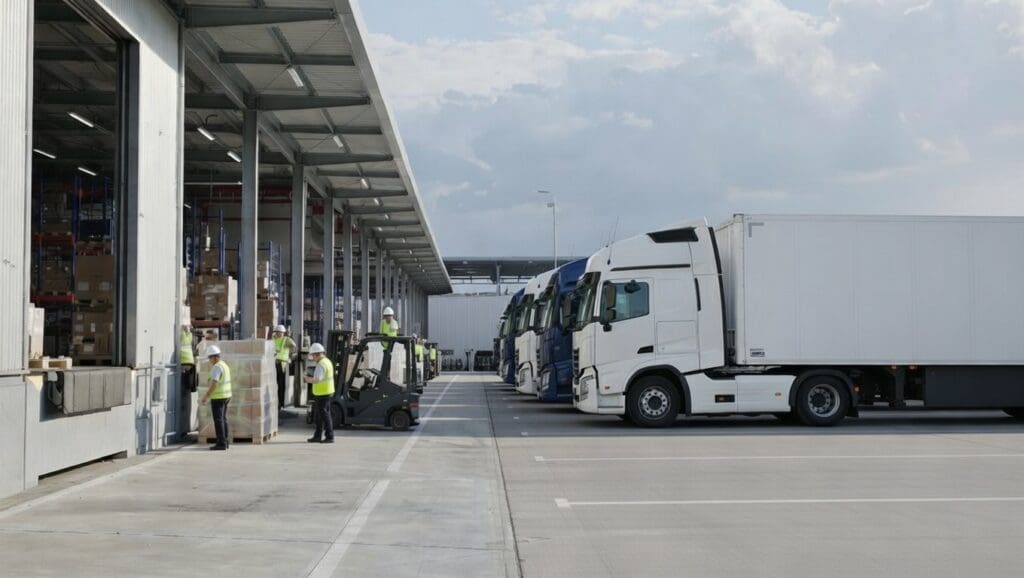
At 07:30, three trucks arrive almost at the same time. One dock team is available. The first shipment contains fast movers needed later that day. Due to the pressure, everything ends up in a buffer. Around 14:00, it turns out that part of it has still not been booked in, forcing picking to improvise with urgent putaways and last-minute relocations.
The pain point
If inbound and receiving are reactive, receiving falls behind, inventory is not available on time, and putaway turns into firefighting. This affects lead time, reliability, and productivity, especially with fluctuating arrival times or a broad supplier mix.
The solution
Treat inbound as a plannable process. With dock control, clear priorities, and fast processing of critical goods, you prevent the rest of your warehouse from falling behind. Inbound optimization is therefore an important part of warehouse optimization.
The approach
- Work with time slots and try to increase appointment discipline among suppliers and carriers.
- Make inbound priorities explicit: fast movers, cross-dock, customer deadlines, customs, special handling.
- Focus on dock-to-stock: from arrival to available inventory, including quality checks and administrative processing.
- Limit buffer build-up: define what may stand in buffer at most and manage putaway as a prioritized task.
- Use pre-advice where possible: know in advance what is coming, including packaging, quantities, labels, and special details.
What you measure
Dock-to-stock time, waiting time at docks, inbound backlog, % of fast movers available within X hours, number of urgent putaways.
Pitfall
Only scaling up with extra people during peaks. Without planning and prioritization, the same pattern returns.
Tip 5: Make data quality a fixed discipline, not an incident
Familiar situation
A picker is standing at a location where the item is packaged slightly differently than expected. The barcode does not match, the weight is incorrect, or the location logic is confusing. The order gets stuck, consultation follows, a correction is made in the system, and meanwhile more exceptions arise.
The pain point
A lot of delay is caused by data, not by people. Incorrect dimensions, incomplete item data, inconsistent locations, or systems that are not synchronized create manual work and errors. In a warehouse linked to transport, e-commerce, automation, and customs processes, that effect becomes greater.
The solution
Treat data quality as an operational responsibility. With ownership, validations, and clear rules, you prevent errors from entering the process. Integrations only work well if the basics are correct. Anyone who wants to optimize warehouse processes cannot separate data quality from operational performance.
The approach
- Assign data owners for SKU, packaging units, locations, batch/lot, customs attributes, and handling requirements.
- Set up validation rules for creation and changes: mandatory fields, logical checks, discrepancy alerts.
- Minimize manual input: avoid duplicate typing between systems, manage using a single source and clear interfaces.
- Make data problems visible: top 10 data conditions that cause exceptions, and solve those structurally.
What you measure
Master data completeness, interface errors, corrections after pick, exceptions per 100 orders, first-time-right.
Pitfall
Only repairing data when something goes wrong. Then your operation structurally runs on exceptions.

Conclusion: Warehouse efficiency comes from focus, rhythm, and a platform that moves with you
An efficient warehouse operation is not a matter of working harder, but of working smarter. The common thread in all five tips is the same: make waste visible, make it measurable, and improve at a fixed rhythm. Fewer walking meters through better slotting, less searching through inventory reliability, more output per employee through standard work and task management, more calm in the operation through inbound and dock control, and fewer exceptions through data quality.
Good warehouse optimization is about structurally improving warehouse processes, supported by data, clear priorities, and the right software. Software plays an important role, especially if you are dealing with complex processes, a lot of variation, and business-critical exceptions. A configurable cloud WMS helps steer priorities, manage exceptions, safeguard data, and make processes scalable. But the effect only becomes maximum if you first clearly understand where the pain lies and which improvement you want to enforce in the daily operation.
If you want to optimize your warehouse, do not start with everything at once, but choose one pain point that has the most impact on your warehouse efficiency. Which of these five pain points do you recognize most in your warehouse, and if you were to improve one thing over the next 30 days, what would you tackle first?