

Transport Planning
AI in transport planning is getting serious, but are you ready for August 2026?
It’s Monday morning. Transport planning is already behind before the first truck departs. An urgent order comes in, a driver calls in sick, and the loading schedule automatically shifts. Your system suggests a new route. Logical, fast, efficient. But something keeps nagging. Why does the system choose this order? Who decided that? And what happens if it goes wrong?
Until recently, those were questions for later. For IT, for innovation, for a pilot. Not anymore. More and more logistics operations are running daily on AI-driven transport planning, while European regulations are moving toward the next phase. And that combination is changing practice faster than many organizations realize.
Quick Navigation:
AI in transport planning
The central idea of this blog: AI in transport planning is no longer the question of whether it works, but whether you can demonstrate how it works, and whether you have it under control before the next phase of EU regulations comes into effect.
The real change in transport planning is happening now, not later
Many organizations still view AI as something that is “coming.” But in practice, it has long been present.
Transport planning, forecasting, replanning during disruptions, it is already happening with algorithms that make decisions. Sometimes visible, often in the background. And it goes beyond optimization. It is about decisions. Who gets which time slot. Which order goes out first. Which driver takes which route. And that is exactly where the playing field is shifting.
Not because the technology has suddenly become better, but because two developments are converging:
- AI is being used operationally, not just tested
- European regulation is moving toward actual application and supervision

August 2026 is the next major step
That second development has a concrete moment: August 2026. This moment does not come out of nowhere, but is part of how European AI legislation is structured and implemented. The rules in question are laid down in the EU AI Act, a law drafted by the European Commission, approved by the European Parliament and the member states, and then introduced in phases. Since early 2025, the first parts have been in force, such as definitions, prohibited applications, and the obligation to provide employees with sufficient knowledge about AI. That was the first step: clarifying what is allowed and what is not.
August 2026 is the next major step. Broader parts of the law will then actually apply to applications considered high-risk. And part of logistics practice falls under this, especially where AI influences planning, decision-making, and the management of people.
From smart planning to demonstrable decisions
Until now, AI in logistics mainly revolved around one question: does it make our planning better? The first answers to that are now available. Practical cases show that smart transport planning can reduce costs, improve routes, and even contribute to electrification. But that phase is over. The new question is: can you explain why the system does what it does?

That sounds abstract, but in practice it is very concrete. Think of situations everyone recognizes:
- A planning that suddenly changes drastically after a small disruption
- Orders that consistently get priority without a clear reason
- Drivers who keep getting the same difficult routes
- Peak pressure that becomes more efficient, but also feels heavier on the shop floor
As long as everything goes well, that is not a problem. But as soon as questions arise, internally or externally, you must be able to show:
- which input was used
- which rules and limits were applied
- where a human intervened
- and why a decision was made
That is the shift: from optimization to accountability within your transport planning.
Why the shop floor will feel the difference
Many discussions about AI remain at the system level. Architecture, models, data. Important, but not where the friction lies.
The real impact is on the shop floor.
Because that is where AI becomes not an abstract system, but a daily reality for every transport planner or logistics planner:
- planners who do less manual planning and must assess more
- supervisors who must explain deviations instead of solving them
- teams that are managed based on output without always understanding the logic
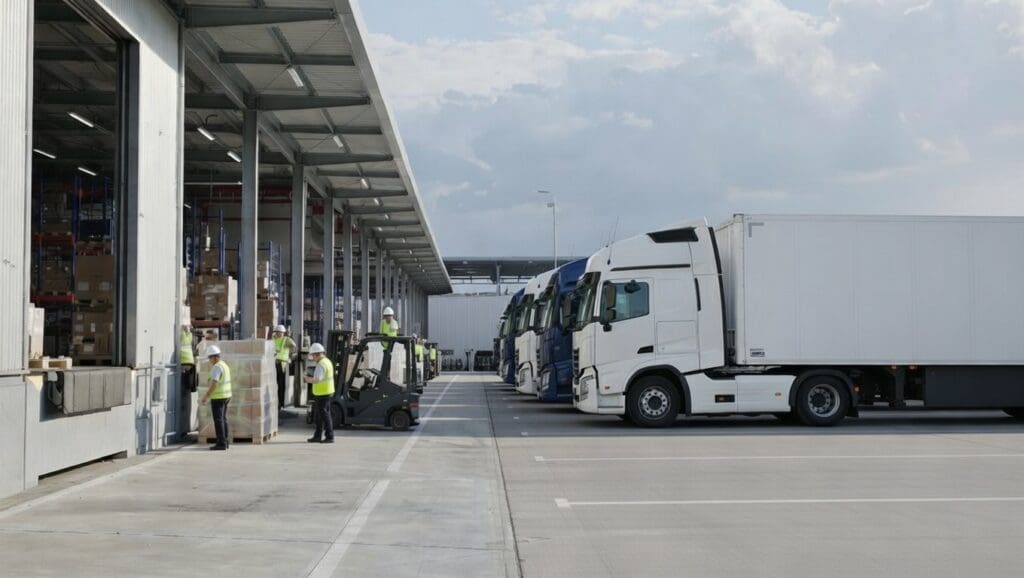
And that creates tension. Not because AI is “wrong,” but because the role of people is changing. Decisions shift from explicit to implicit. From visible to hidden within systems. At the same time, attention to exactly that point is growing. In Europe, there is increasing focus on algorithmic management of work, monitoring, and fairness. This makes it no longer purely a technological story. It is an operational and organizational story around logistics planning.
The paradox: more automation requires more control
On paper, AI mainly seems to take work off your hands. Less manual planning, fewer exceptions, faster responses. In practice, the opposite happens. The more you automate, the more important it becomes to understand what is happening within your transport planning software.

You can see this reflected in what organizations now need to organize:
- audit trails: being able to see who decided what
- override structures: when a human is allowed to intervene
- threshold values: what the system must never decide on its own
- data insight: where decisions come from
Not because someone “imposes” it, but because it is necessary to maintain control.
And that is exactly where many organizations get stuck. Not on technology, but on organization.
The next 12 months will be selective
Looking ahead, you do not see uniform acceleration. You see selection. One part of the market moves forward. They connect AI to processes, build in controls, and learn from deviations. There, transport planning becomes faster, more consistent, and better explainable. Another part remains stuck in pilots. Good results, but no structural embedding. There, it remains dependent on individual knowledge and manual corrections. And then there is a third group that slows down. Not because AI does not work, but because the organization is not ready. The run-up to August 2026 will make that difference visible. Not in technology, but in the maturity of logistics planning.
What does this concretely mean for your operation?
You are probably already working with logistics systems that make or advise decisions within your logistics operations or transport planning software.
You may notice it especially during busy moments. You may only notice it when something is off.
The question is not whether that is the case. The question is: do you have visibility?
- Do you know when the system decides and when a human does?
- Can you explain why a plan changes?
- Is it clear where the limits of automation lie?
- Can you demonstrate what happens in case of deviations?
If the answer to these questions is uncertain, that is where the real work lies. Not in new technology, but in making visible what is already happening.

Conclusion: why control in transport planning with AI will become more important than optimization in 2026
AI in transport planning is no longer a future scenario. It is already part of operations, often without being explicitly labeled as such. What is changing is not the technology itself, but the context around it. European regulations are moving toward application and supervision, while organizations are trying to scale AI right now. That makes one question decisive: can your organization still explain and control what your systems are doing within your transport planning before that is required from the outside?
For many logistics operations, that is the real challenge of the next twelve months. Not smarter planning. But better understanding.
Sources and background
- European Commission, AI Act Service Desk, implementation timeline and FAQ
https://ai-act-service-desk.ec.europa.eu/en/faq - European Commission, guidelines on prohibited AI practices, February 2025
https://digital-strategy.ec.europa.eu/en/library/commission-publishes-guidelines-prohibited-artificial-intelligence-ai-practices-defined-ai-act - European Commission, AI Continent Action Plan, April 2025
https://digital-strategy.ec.europa.eu/en/library/ai-continent-action-plan - BCG and Alpega, research on AI adoption in logistics, March and April 2026
https://www.bcg.com/publications/2026/ai-is-already-moving-the-logistics-industry-forward
https://www.alpegagroup.com/en-en/company/press/european-logistics-faces-fragmented-ai-adoption-according-to-new-industry-findings/ - Fraunhofer ISI and EU Urban Mobility Observatory, case study AI fleet planning, June and July 2025
https://www.isi.fraunhofer.de/de/presse/2025/presseinfo-08-einsatzplanung-elektro-lkw-potenziale-kosten.html
https://urban-mobility-observatory.transport.ec.europa.eu/news-events/news/ai-fleet-planning-cuts-logistics-costs-and-boosts-electric-truck-use-2025-07-03_en - Joint Research Centre (EU), research on algorithmic management and digital monitoring in the workplace
https://joint-research-centre.ec.europa.eu/projects-and-activities/employment/algorithmic-management-and-digital-monitoring-work_en - European Parliament, resolution on AI and work, December 2025
https://www.europarl.europa.eu/doceo/document/TA-10-2025-0337_EN.pdf - CNIL and EDPB, guidelines on AI and GDPR in 2024 and 2025
https://www.cnil.fr/en/ai-cnil-finalises-its-recommendations-development-artificial-intelligence-systems
https://www.edpb.europa.eu/news/news/2024/edpb-opinion-ai-models-gdpr-principles-support-responsible-ai_en