

eFTI regulation
eFTI changes your audit conversation; soon it will no longer be about paper, but about proof
It is Monday morning, the schedule is under pressure, and your team is already running in peak mode. A last-minute change comes in, a shipment is split, a trailer switches drivers at the last moment. Meanwhile someone walks around with a simple question you immediately recognize: “Can we prove that this is correct?” Not because you don’t trust your people to do their work, but because you know how it goes with exceptions. One mismatch between what physically leaves and what is recorded in the chain, and you lose time, lose the discussion, sometimes even lose reputation.
In this blog you will read what eFTI means in practice for logistics and warehouses, and why audits increasingly revolve around transport data instead of documents.
eFTI: why audits will soon revolve around data
eFTI is the European framework that requires transport information, which now often circulates on paper or as PDFs, to be available in a standardized digital form for inspections by competent authorities. Within this eFTI regulation for transport and logistics, it is about making transport data electronically available to inspection services.
eFTI is added to that. Not as extra paperwork, but as a shift in how proof works in transport and therefore in your warehouse. The core: “paperless freight” is less about having less paper, and more about demonstrability, access, and logging.
The common thread: eFTI makes provability part of your operation
You can see eFTI as an IT file. Or as something that “transport” will handle. But in practice it returns faster to where you are: at the moment when transport data is created, changed, and confirmed. And that moment is often in the warehouse.
The movement you see in this subject is simple to describe and difficult to ignore:
We move from showing documents to being able to prove transport data
That sounds abstract until you translate it into your daily reality. Not the perfect, planned shipment. Precisely the shipment with rough edges.
- A consolidation that changes at the last moment
- A split shipment because there is a shortage
- A weight that turns out differently than expected
- A label that is reprinted
- A carrier swap due to capacity problems
In that world, “proof” is not a PDF. Proof is a chain of events that you can still reconstruct later through digital transport information.


What is really new now: it becomes buildable and verifiable
Until now you could still dismiss eFTI as a framework, something that is coming. What gives the material its journalistic sharpness is that it now shifts to something concrete: functional requirements for eFTI platforms have been published and there is a clear movement toward an operational preparation phase starting January 2026. That is the tipping point. Not because everyone will work differently tomorrow, but because the subject moves from the realm of intention to the realm of execution.
From this point, the question inevitably becomes more practical: How will access to transport data be arranged in case of an inspection request? How do you demonstrate which dataset was used, and when it was established? How do you prevent being “right” but unable to prove it? In practice, this is exactly what audits and enforcement will rely on. Less “just show what you have with you,” more “show how you can substantiate it.”
Why this affects your warehouse: this is where the truth of the shipment arises
A supply chain manager has known this for a long time, but it is good to say it out loud: in logistics and transport, the truth of a shipment does not exist in one system. It arises in steps. And many of those steps are on your floor.
Think about the shipping moment. The load is ready, there is staging, there is a seal, there is a load confirmation. These are not just operational actions. They are proof events within the logistics data stream.
The material emphasizes controlled, digitally authorized access and logging around access to transport information.
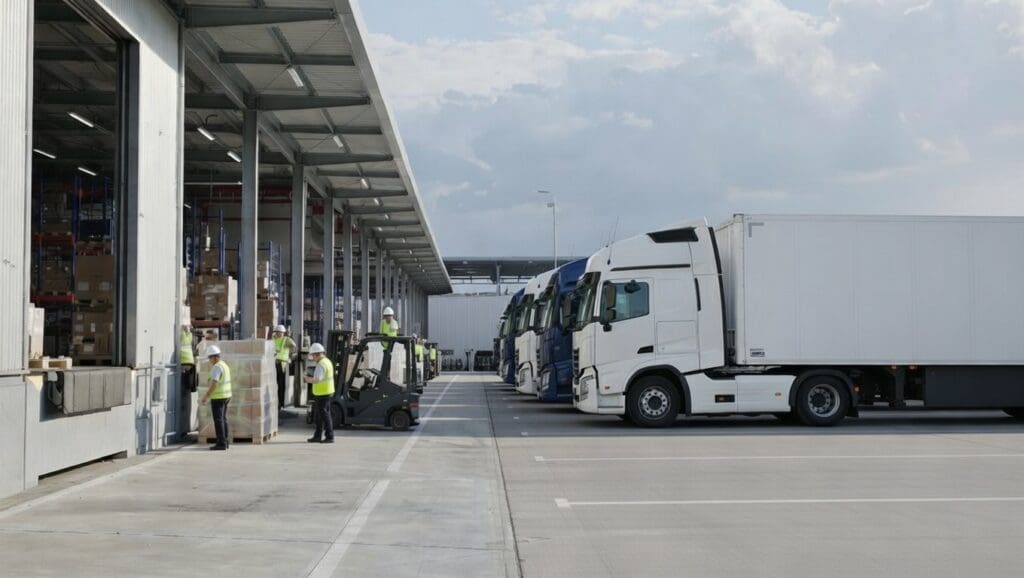
That means your warehouse comes into view in two ways:
- Datakwaliteit: klopt wat er in de dataset staat met wat er fysiek vertrekt?
- Traceerbaarheid: kun je achteraf laten zien hoe dat zo is gekomen binnen je digitale logistieke processen?
Als dat in orde is, wordt “paperless freight transport” bijna saai, op de goede manier. Als het niet in orde is, worden uitzonderingen ineens auditmomenten.
Wat je vandaag “even oplost”, kan morgen precies het gat in je bewijsverhaal zijn.
The biggest shift lies in exceptions, not in the standard flow
The standard flow is rarely the problem. Orders move, scans match, the truck departs. The point where provability begins to pinch is where your operation always pinches: exceptions. A few recognizable situations in which eFTI and digital transport documentation raise the bar, without it being announced that way:
Last-minute changes: another trailer, another carrier, a later dock slot. Operationally logical, but technically a risk for proof if the transport dataset “lags behind.”
Consolidation and split: combining or splitting shipments is routine, but it changes colli structure, weights, and references within transport data in logistics systems. Without clear before-and-after registration, you get discussion afterward.
Reprinting, repacking, relabeling: it always happens. The question is not whether it happens, but whether you can explain why, by whom, and exactly what changed in the digital transport information.
Short ship and damage: claims and inspections get stuck on mismatches. Not because your process is bad, but because the timeline of corrections is not recorded firmly enough within your transport data and logistics systems.
You do not have to “lock everything down” for this. But you do need to know which moments you treat as proof moments. That is a different mindset than simply running performance.

This is what “provability” looks like on the floor
Without falling into policy language, you can make provability practical. The material provides guidance for that, especially through the idea of controlled access, logging, and standardized datasets.

Vertaal dat naar je warehouse en je krijgt een set eenvoudige, maar scherpe vragen:
- When is a shipment “locked” as a version so it is clear what has been shared?
- Which changes are still allowed after that, and who may decide that within your logistics system?
- For each exception, can you show who did it, when, and on what basis within your digital transport documentation?
- Is the difference between “physically departed” and “digitally recorded” small enough not to be a risk?
Sometimes it helps to choose one key moment and organize that really well. For example, the loading moment.
Make “load confirm” not just a checkbox on a screen, but a proof event: time, seal, deviations, authorization. Not heavy, but precise.
What this will likely mean in the next 12 months: more parallel reality
The material does not sketch absolute certainties, and that is good. The movement is clear: 2026 is a preparation year in which pilots, different speeds per member state, and chain pressure can exist side by side.
For you, that mainly means one reality: you will likely have a period in which you serve two worlds at the same time.
- Some parties already want to work with digitally provable processes.
- Other links in the chain will continue to rely on paper.
- And you are in between, with the same peak pressure, the same exceptions, the same KPIs.
That does not require a perfect end state, but a robust foundation: data quality, traceability, and a mature exception process.

Conclusion: it is not about paperless, but about provability
The temptation is great to see eFTI as “something that is coming.” But the material shows something else: the subject is moving toward execution, with more concrete requirements for platforms and a shift toward operational preparation starting January 2026. This changes the audit conversation in transport and logistics. The question you can ask yourself is simple:
If tomorrow someone asks “can you prove it?”, is your answer a folder, or a timeline?
If you can deliver that timeline, calmly, completely, reproducibly, then paperless freight transport almost becomes secondary. Not because it is less important, but because your operation then proves what it does, even when things get messy.
And that is exactly what trust in logistics ultimately rests on.
Sources and background
Europese Commission
European Commission, DG MOVE.
eFTI Regulation (Electronic Freight Transport Information).
Overview of the purpose, operation, and implementation timeline of eFTI.
https://transport.ec.europa.eu/transport-themes/logistics-and-multimodal-transport/efti-regulation_enEuropean Commission.
Towards paperless freight transport: EU takes step forward with eFTI implementation.
News article about the implementation phase of the eFTI regulation, 9 January 2025.
https://transport.ec.europa.eu/news-events/news/towards-paperless-freight-transport-eu-takes-step-forward-efti-regulation-implementation-2025-01-09_en
EU legislation
European Parliament and Council.
Regulation (EU) 2020/1056 on electronic freight transport information (eFTI).
Official Journal of the European Union, 2020.
https://eur-lex.europa.eu/eli/reg/2020/1056/ojEuropean Commission.
Delegated Regulation (EU) 2024/2024 of 26 July 2024
supplementing Regulation (EU) 2020/1056 with regard to the common eFTI dataset and eFTI data subsets.
Published in the Official Journal on 20 December 2024.
https://eur-lex.europa.eu/eli/reg_del/2024/2024/ojEuropean Commission.
Delegated Regulation (EU) 2024/2025 of 15 July 2024
amending Annex I to Regulation (EU) 2020/1056 concerning the scope of regulatory information.
Published in the Official Journal on 20 December 2024.
https://eur-lex.europa.eu/eli/reg_del/2024/2025/ojEuropean Commission.
Implementing Regulation (EU) 2024/1942 of 5 July 2024
laying down common procedures and detailed rules for access to and processing of electronic freight transport information by competent authorities.
Published in the Official Journal on 20 December 2024.
https://eur-lex.europa.eu/eli/reg_impl/2024/1942/ojEuropean Commission.
Implementing Regulation (EU) 2025/2243 of 6 November 2025
laying down functional requirements for eFTI platforms.
Published in the Official Journal on 7 November 2025.
https://eur-lex.europa.eu/eli/reg_impl/2025/2243/oj